Possibility: Reflections on AI, Creativity, and Where Art Lives
 I recently attended a presentation for WAG, given by author Jaimie Engle, on writers working with AI. As you might imagine, the conversation was lively — questions and concerns, ethical debates, excitement, more than a little skepticism, and just as much curiosity.
During the presentation, I shared an experiment from the day before. I had written the first half of a poem, then invited ChatGPT to finish it, asking for a line-by-line explanation of its choices. I wanted to understand how AI would build on a voice it had come to know through long months of training and collaboration. I was surprised by how thoughtful, how accurate, it turned out to be. What it created was so unmistakably me that I was slightly stunned. But it was the explanations that stayed with me. It gave me new insight into myself as a creative.
The conversation that followed had nothing to do with AI replacing my creativity, and everything to do with understanding it. We talked about rhythm, metaphor, pacing, imagery, emotional resonance. Editing the piece, I found some AI lines sparked ideas I hadn’t considered, sending me back to rewriting from an angle I hadn’t yet seen. Other lines mirrored, almost exactly, where I had already planned to go. What emerged was a poem neither of us would have written alone.
I found myself thinking about an article I once started on art photography and how coldly the camera was received when it first arrived. Painters and critics who had spent lifetimes mastering brush and pigment looked at a machine…this button-push miracle…and recoiled. One 1855 critic insisted that because true art required invention and feeling, photography could never rise above mere engraving. The renowned painter, Edvard Munch, went further, saying the camera would never rival the brush until it could be carried into heaven or hell. More than a century and a half later, the language has softened, but I recognize the same anxious note underneath our conversations about AI.
And yet photography didn’t destroy painting — it liberated it. For centuries, painters had carried the burden of recording reality: faces, landscapes, battles, ceremonies. Once a camera could do that work in an instant, painters were suddenly free to ask a different question: what else is possible? That single shift in the ground beneath their feet helped open doors to Impressionism, Expressionism, Cubism, and other movements that didn’t just change what art looked like, but what art was for. The camera didn’t shrink the territory of art, it expanded it, creating those new possibilities; and possibility is the word I keep returning to when I think about AI.
What possibilities might now exist as we writers step into this new shared creative space? How do we move forward with our eyes open without letting fear talk us into throwing out something worth keeping or pretending the hard questions aren’t real? How do we make peace with this new tool without losing ourselves in the process?
I found a version of that peace once before, with another suspect medium: digital art. After finishing my degree in graphic design, I moved from pastel painting to digital work — not because I loved traditional media less, but because I’d become fascinated by what this new medium might let me say. I joined a local artists’ group, and at first, I was welcomed warmly. They seemed to enjoyed discussing my fine art background and praised my traditional work. But the moment I mentioned digital art, something in the room shifted. Conversation stopped. I had crossed an invisible line, and the look on many faces said it plainly: you are no longer one of us.
At the time, it devastated me. Now, I’m strangely grateful for it, because it taught me something I hadn’t understood yet:
We don’t always reject new tools because they lack creative potential, sometimes we reject them because they ask us to redefine what creativity even looks like.
Digital art wasn’t the first medium to be met that way, and photography wasn’t the first tool. Scribes once feared the printing press would cheapen the sacred labor of the copied word. Musicians once fought (and sometimes banned) the synthesizer, certain it would empty the stage of living players. Long before any of that, the novel itself was considered frivolous, a little dangerous even — something that might seduce readers into fictional lives at the expense of their real ones.
History has an odd sense of humor. We often meet the new with the same fear…that this time, finally, art will end. And yet, every time, art survives. Not because it refuses to change, but because artists are willing to. And change, although often frightening, is the catalyst for growth.
Ten years ago, I went through a change of my own. I became disabled.
The fatigue and brain fog that come with chronic illness altered how I create; it forced adaptation. I can no longer travel long distances chasing the perfect light. I can no longer stand at my easel for hours, nor hold a guitar to write my songs. Did the artist disappear? Not for a moment. She just needed different tools. Today, I draw on everything I know about composition, lighting, color, and story, and translate it into carefully written prompts to create images reflecting visions already living in my imagination. I use AI to help compose music trapped in my soul.
It’s much the same in my writing. Some days, organizing my thoughts feels like trying to catch smoke with my hands. AI doesn’t give me my ideas. It helps me organize them, research them, sometimes it asks a question I hadn’t thought to ask myself. Sometimes it offers a possibility that sends my own imagination somewhere entirely new. The creativity isn’t coming from the software; it’s happening in the space between us… in the exchange. And that realization led me to a bigger question — not: “Am I giving my creativity away through this conversation?” but: “Where does creativity actually live within conversation in the first place?”
When most of us hear “conversation,” we picture two people trading words. But I wonder if conversation is larger than that. A poem speaks to us. A photograph moves us. A book changes us. None of them literally say a word, and yet each one asks something of us. Not an answer. Just our attention. And in giving it, we start a dialogue — with the work, and maybe with ourselves.
Every creative life is shaped by conversations like that…with people, with experiences, with art itself…and conversations give rise to collaboration. I’ve come to believe creativity has always been collaborative, because every work is born out of relationship, even when that relationship is with no one but ourselves.
That belief has changed how I think about artificial intelligence. I no longer see it sitting at the center of the conversation. It’s simply one more participant at the table. That doesn’t mean the hard questions disappear — ethics, copyright, transparency, originality, responsible use — those questions matter, and they deserve to stay loud. But I’ve started asking a different question alongside them. Not: “Did AI help make this?” but “Did AI help the maker enter more fully into conversation with their own true artistic self?”
Working with AI, I’ve discovered something I didn’t expect. It hasn’t made me feel less like a writer. It’s made me think harder about why I choose one word over another, why one rhythm lands and another falls flat, why one image feels true and another merely decorative. It hasn’t answered those questions for me. It has asked them of me; and in doing so, it’s helped me hear my own voice more clearly than I did before.
That, I think, is the real mark of a good collaborator: not someone, or something, that does the work for us, but something that invites us further into the work itself. Every artist already stands in conversation with everyone and everything that shaped them; we’re built from dialogues that keep speaking long after the voices themselves go quiet.
I don’t believe AI is taking over the conversation. It’s simply holding the door open a little wider. Right now, that conversation is full of skepticism and fear, and probably should be; those instincts protect something worth protecting. But it’s also full of curiosity and hope, and I want to protect that too. Every new tool asks hard questions, but also asks hopeful ones, the ones that open us toward possibilities we’ve yet to discover. Because the best collaborators — whether they’re teachers, friends, or something as strange and new as artificial intelligence — don’t replace our voices, they help us hear them.
History suggests every generation believes its newest tools threaten creativity. History also suggests something else… that creativity has never lived inside the tool, but inside our willingness to imagine new possibilities.
And perhaps possibility has been where art has lived all along.
POSSIBILITIES:
Synthetic Photograph Prompt, written by Margaret S. E. Smith for ChatGPT Image.
PROMPT: Create a timeless black-and-white fine art photograph.
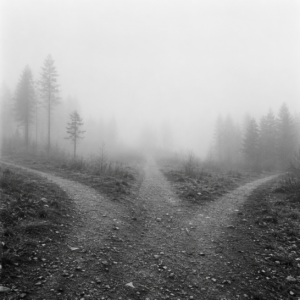
Three woodland paths disappear into dense morning fog. The paths begin prominently in the lower third of the frame, creating elegant leading lines that naturally draw the viewer’s eye forward before disappearing into the fog. The composition should emphasize the geometry of the fork while allowing the mystery to remain unresolved.
Allow the upper two-thirds of the image to dissolve into luminous white mist, creating expansive negative space that conveys openness rather than confinement. The fog should obscure the destination without feeling ominous. The atmosphere is calm, quiet, and deeply contemplative.
The surrounding trees should emerge only faintly from the mist, their forms softened by distance but still believable. The foreground should remain crisp and richly textured, with damp earth, scattered leaves, subtle grasses, and small stones rendered in exquisite detail.
Photographed as though using a Hasselblad 500C/M with an 80mm Zeiss Planar lens, f/8–f/11, with a slightly extended exposure that gently softens the drifting mist while preserving sharp detail in the landscape. Captured on Ilford HP5 Plus, exhibiting rich tonal separation, luminous highlights, deep blacks, delicate shadow detail, and subtle, natural film grain.


Michelle Dunlap
Thank you Maggie. Your post is very thought-provoking, and I find your photography analogy so very helpful.
Margaret S. E. Smith
Thank you, Michelle; I appreciate that very much. 🙂
Michelle Marcotte
A very well written article, persuasive even, but I remain sceptical in large part because AI was built and continues to be built on theft, without compensation to the person who unknowingly and and without permission created it. Publishers are rightly refusing to publish AI created work for legal and copyright reasons. Furthermore, it seems creative people who use AI to generate their work do not seem to publicly admit it, combining theft with lying. The AI companies are gathering unimaginable wealth that should have been and should be shared – but is not.
Margaret S. E. Smith
Hi, Michelle. Very thoughtful and important concerns, to be sure; however, there is much more to this than many people realize, mostly due to many changes in this arena. It seems to me that inevitably, with any new technology or tool, etc, there come problems such as these… not just with AI… and these always need to be worked out as people vacillate between the extremes of “this is all bad” and “this is all good.” We humans, we do seem to be creatures of extremes until we settle into some form of balanced homeostasis. Some of these issues tend to get intertwined, when that doesn’t give us an accurate or full picture. One of the biggest issues is how AI models are trained. There are legitimate legal and ethical questions about whether copyrighted works should have been used for training without permission or compensation. Courts around the world are still working through those questions, and reasonable people can disagree about where the line should be. Very legitimate concerns that are still being worked out, but it’s important to know that many AI systems are now being trained on licensed material, public-domain works, openly licensed content, or content whose creators have chosen to participate. Companies are also making licensing agreements with publishers, news organizations, musicians, photographers, and stock image libraries. The landscape is changing rapidly, and it isn’t accurate to describe every AI system today as operating under the same practices as the earliest models. My research shows that ChatGPT is one that has made strong strides in respecting published and protected work. The second issue, disclosure… well, that one I agree with you for the most part, but again, I don’t believe it is that simple. A lot depends on just how much of the finished work was literally created by AI. I was really impressed with what Jaimie said about why she doesn’t disclose her use of AI in her work, that being, for the same reason she doesn’t disclose she used Microsoft Word or Grammarly… she uses it as a tool just like those tools… not to create the work, but to assist her in her own creation. This is also how I use AI. Lastly, there is the issue of wealth and power, which I think is more of a very human problem. These same concerns have been asked about photography, recorded music, search engines, social media, and streaming services. Who benefits? Who gets paid? How do we compensate creators fairly? Those are real questions, and society hasn’t always answered them well. Personally, I don’t think the ethical concerns surrounding the companies automatically determine the ethical value of the tool itself. A camera can be used ethically or unethically. So can Photoshop, a printing press, or AI. I believe our responsibility is to shape the technology toward transparency, consent, fair compensation, and human creativity—not to assume that every use of it is inherently unethical. The ethical issues are very real, and we have to keep addressing them and improving how we use tools while not stepping over lines that shouldn’t be crossed… but I also believe we shouldn’t throw out the baby with the bathwater. 🙂 Thank you so much for your comment Michelle; I truly appreciate this type of discourse.
Page
Since the data involves the input generated by humankind, the creations will reflect that. However when a single person writes there is the view of the singular mind that is not to be conflated with a general-purpose take on an idea… thus the unique perspective is infinitely more valuable than a collage of ‘what mankind has produced up to now’. Collaborative art may be fine, but it does seem a dilution of the individual. Many can see three paths diverging in a gray wood but all of them would see it differently and therein lies the beauty. ‘Three paths diverged in a gray wood and – I, I took the one less traveled by.’
Margaret S. E. Smith
Hi, Page. I think that is one of the beautiful things about the creative process… it cannot help but be collaborative to some extent, because we are deeply social, connected beings. Because of that, it is, in my thinking, impossible to create without being affected by things and people that came before. We cannot singularly live in a vacuum, untouched by our experiences, the people we’ve known, the things we’ve learned, the creative expressions of the ages. I believe a single individual’s creations, by the very nature of what it means to be human, cannot help but be an amalgamation… a collaboration, if you will… of the things that have shaped us into the individuals that we perceive ourselves to be. From my personal experience, when used correctly and ethically, AI can enter into collaboration with the creative in the same way a friend, family member, or teacher can during the exchange of thoughts and ideas. When an AI says: “That’s very good A, but see here: did you consider B and C?” and you answer: “No, I don’t really understand A and never heard of B… but, wow… tell me more about A and B, they sound interesting.” Then AI tells you about B and C, and in that exchange, you suddenly get an idea that you could combine A and C to create D… a totally new creative idea that didn’t exist before… that is not AI giving you D… that is exchange, collaboration, conversation that results in something new and unique to you. This is the nature of and very essence of art… creation through discovery, learning, understanding, experiencing, and bringing the unique totality of you to act as the catalyst for something brand new. 🙂
Debbie
Excellent post and great writing! Thanks for the clarifications and reminders of our fearful history of new inventions.
Margaret S. E. Smith
I appreciate that, Debbie. Thank you.
Cynthia Bertelsen
Excellent summation and probing of this new, frankly exciting technology. The collaborative aspect of AI intrigues me, because I don’t really have many options for bouncing ideas off anybody.
Margaret S. E. Smith
Thank you, Cynthia. Yes, you touch on another important area I’ve considered. Just like the disabled (such as myself) who can’t physically or cognitively do what we used to do to create, those who don’t have easy access to people to bounce ideas off of can use AI as a way to compensate for that. Every technology and tool has the possibility of being abused, but it would be foolish (in my opinion) to turn our backs on something that can be very helpful, just because some will always seek to use it unethically. Thank you again for the comment. 🙂
Glenna Auxier
There is no difference, i can see, in each road other than right center and left. For example, nothing foreboding or inviting. If this art were to accompany Frost’s poem, I wouldn’t see the possibilities as if there had been perhaps: a well worn path, a road highlighted by sun or moon or a road that continues in view or has a view ending more quickly… bryar or flower trimmed. I suppose this can all be programmed into AI but it’s what struck me in the AI rendering. Something about AI frightens me. At 83, it could be that having just started to get a leg up on my creativity, now comes something new to contend with. It could be the same way the last cavemen felt when paint and canvas came along.
Margaret S. E. Smith
Hi, Glenna. Your point is well taken, but what is lacking in the photo is my human doing, not the AI. I wrote the prompt for the image very quickly to have a visual to go along with the article, as was requested for me to provide. It simply saved me time from spending hours going through free-to-use photographs on Pixabay or some other stock photo website, and my health doesn’t allow me to trek out into the wilderness to get a traditional photo anymore. When actually working to create artistic synth-photography, I take much more time and care with my prompts. And I absolutely understand your fear of AI; you certainly aren’t alone. But my experience has been that fear comes naturally with anything that is new and has the potential for misuse (as so many things can be). But it is in learning all we can about these things that will make them tools that we have the knowledge to use wisely while also protecting ourselves from how others may use them unethically. AI is not going to go away, and the greatest power we can have is in understanding all that we can about what it is, how it can be used for good, and how it can be destructive. At least, that’s what I’ve come to believe as someone on the tail end of age 61. 🙂 Thank you for your comment on the article; I truly appreciate it.